
⚠️ Disclaimer
All price predictions in this article are analytical references based on historical data, tokenomics, and macroeconomic market trends, and do not constitute investment advice. The cryptocurrency market is extremely volatile, and NFP has currently fallen over 98% from its all-time high. Please conduct independent research before investing. Data as of: June 2026.
I. Before Understanding NFP, Understand the Project Itself
Many readers jump straight to the conclusion when seeing a price prediction article without understanding NFP's project background.
NFPrompt is an AI-driven UGC platform designed for the new generation of Web3 creators. Its native token, NFP, assumes the core functions of staking, payment, and governance within the ecosystem.
Core platform features include:
- AI Creation Tools: Supports generating art, music, or videos, such as Studio Ghibli-style works.
- NFT Minting: User creations can be directly minted into NFTs to participate in on-chain trading.
- Themed Campaigns and Community Governance: Users can participate in platform campaigns, voting, and reward distribution.
The total supply of NFP is 1 billion, with a circulating supply of approximately 250 million (25% of the total) at launch. The platform runs on BNB Chain and opBNB.
Competitors include Render Network, Fetch.ai, etc., but NFPrompt still holds a moat in combining the dual tracks of AI + NFT.
Tip: Data referenced from the Binance Research whitepaper and official on-chain verification information.
II. NFP Price History
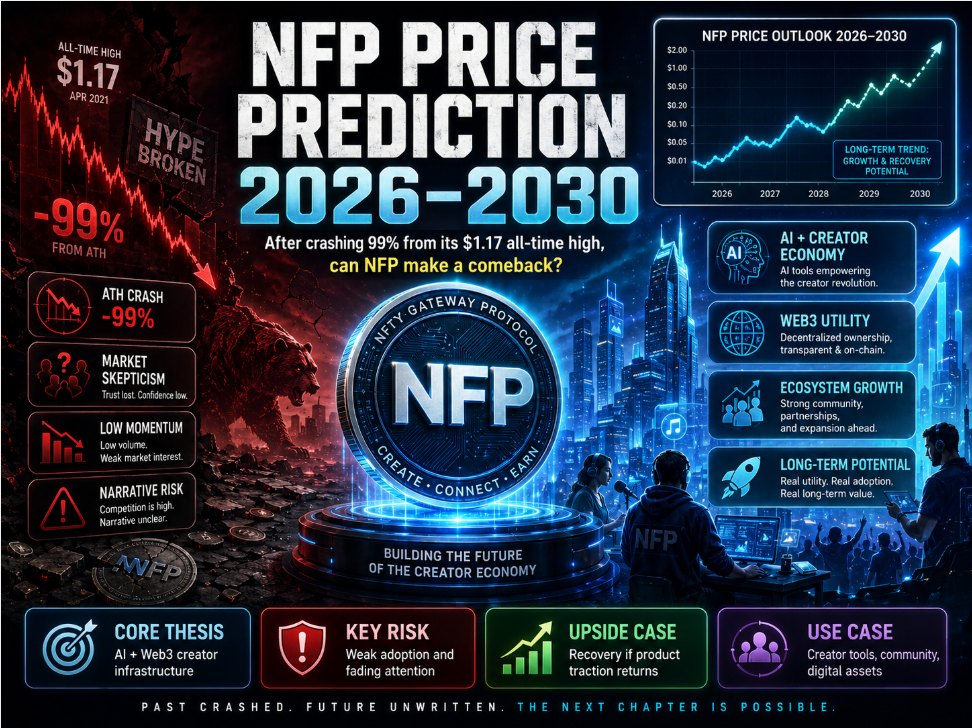
NFP was listed via Binance Launchpool on December 19, 2023, with an all-time high of $1.17 and an all-time low of $0.01160. The current price is approximately 1% of its all-time high.
The price collapse went through several stages:
- Initial Premium Stage: Driven up by the Launchpool halo during its early listing phase.
- NFT Market Cooling Stage: NFT hype declined between 2024–2025, reducing platform demand.
- Unlock Pressure Stage: Selling pressure emerged after locked tokens from the team and investment institutions were released.
- AI Free-to-Use and Lack of New Narrative Stage: User demand and ecosystem activity failed to sustain growth.
NFPrompt adopts a continuous token burn strategy. The most recent was on March 30, 2026, marking the 18th burn of 3 million NFP. Despite the accumulated burn volume, the price remains affected by market demand and macroeconomic trends. The current price approaching its all-time low is not necessarily a buy-the-dip signal; it could also be proof of value destruction.
III. Five Core Variables Driving NFP's Price
1. Tokenomics and Deflationary Mechanism
Continuous burning is the core of its tokenomics, but it must be combined with user growth and actual demand. The Fully Diluted Valuation (FDV) is approximately $13.34 million, and the circulating market cap is $6.7 million. The large gap implies potential selling pressure.
2. Dependency on BNB Chain and Binance Ecosystem
Highly dependent on BNB campaigns and ecosystem collaborations. Changes in the holding strategy of YZi Labs (formerly Binance Labs) may impact the price.
3. Market Cycles of AI and NFT Dual Tracks
The NFT market is shifting from speculation to utility value. Does NFPrompt fit the new narrative? Furthermore, the free-to-use trend of AI tools (like Midjourney, Stable Diffusion, Sora) may weaken paid usage scenarios.
4. Bitcoin Halving and Overall Bull/Bear Rhythms
The 2024 Bitcoin halving is complete. History shows that altcoins generally experience a broad rally window 12–18 months after a halving.
5. Competitive Landscape and Actual Platform Data
Monthly active users, NFT minting volume, and trading volume are key metrics. Pay attention to changes in market share compared to competitors like Manifold, Zora, and ArtBlocks.
For a comparison with mature assets, you can refer to the HiBT LTC Analysis and DOT Introduction to help understand NFP's risks and value.
IV. Horizontal Comparison of Institutional Predictions
- One institution predicts a maximum price of $0.1903 and an average of $0.1575 for NFP in 2030.
- Another algorithmic model provides an extremely low forecast.
- Technical analysis models show a minimum price of $0.1253, a maximum price of $0.4669, and an average of $0.2847 in 2030.
Crypto predictions often carry a bullish bias. Judgment criteria should include transparent methodology, visible pessimistic scenarios, and trackable historical records.
V. NFP Year-by-Year Price Prediction (2026–2030)
Methodology Note: A comprehensive evaluation based on tokenomics, platform fundamentals, macro crypto cycles, and AI/NFT track trends. The numbers are for analytical reference only.
- 2026 (Circulating market cap: ~$7.84 million, Supply: 620 million)
- Bull Market: $0.05–$0.12
- Base Case: $0.02–$0.05
- Bear Market: $0.008–$0.015
- 2027
- Bull Market: $0.15–$0.45
- Base Case: $0.04–$0.10
- Bear Market: $0.01–$0.03
- 2028
- Bull Market: $0.10–$0.30
- Base Case: $0.03–$0.08
- Bear Market: $0.008–$0.02
- 2029
- Bull Market: $0.50–$2.00
- Base Case: $0.08–$0.25
- Bear Market: $0.01–$0.04
- 2030
- Bull Market: $0.30–$1.00+
- Base Case: $0.08–$0.25
- Bear Market: $0.005–$0.02
VI. Potential Returns and Risks of Holding NFP until 2030
- A $100 investment at the current price of $0.013 could reach $2–$3.5 in a bull market, roughly $8–$25 in a base scenario, and potentially drop to $0.008–$0.02 in a bear market.
- Opportunity Cost: Compare with BTC, ETH, or S&P 500 index funds.
- Position Management: Small-cap, high-risk tokens should ideally account for ≤5% of total assets.
VII. Top 5 Risks of Investing in NFP
- Threat of Free AI Tools: Diminishes the need for the platform's paid services.
- Structural Contraction of the NFT Market: Less overall demand in the sector.
- Token Unlock Selling Pressure: Approximately 465 million tokens remain uncirculated.
- Liquidity Trap: Market cap is under $8 million.
- Regulatory and Compliance Risks: Uncertainties regarding copyright and security classification.
VIII. Who Should Buy vs. Who Shouldn't Buy
Suitable For:
- Investors who already hold base positions in BTC/ETH.
- Those who can tolerate a 100% loss.
- Those who have conducted independent research on the AI+NFT track.
Not Suitable For:
- Complete beginners.
- Those making NFP their primary bet.
- Those seeking stable cash flow.
You can refer to alternative assets with larger market caps and better liquidity: LTC Analysis, DOT Introduction.
IX. Three Future Paths
- Optimistic: The AI NFT craze revives, NFPrompt becomes a category leader, and the price returns to $0.50+.
- Base Case: Moderate operations, with the price ranging from $0.05–$0.20.
- Pessimistic: AI tools become free, the NFT market remains sluggish, and the price drops to $0.005–$0.02.
Five Self-Check Questions Before Entering:
- Do you understand NFP's business model and user demand?
- Can you afford your investment going to zero?
- Does your investment horizon cover a complete bull and bear cycle?
- Does this investment account for ≤5% of your total assets?
- Is your decision based on independent research?
FAQ: NFP (NFPrompt) Frequently Asked Questions
1. What is NFP?
NFP is the native token of the NFPrompt platform, serving the AI-driven Web3 UGC creation and NFT minting ecosystem. It handles staking, payment, and governance functions. It differs from general altcoins as it relies on platform usage scenarios and token-burning mechanisms to maintain its value.
2. What is the relationship between NFP and NFT / AI tools?
NFP is the platform's payment and governance token. Users must spend NFP to use AI models for generating artworks or minting NFTs. If mainstream AI tools (such as Midjourney or Stable Diffusion) become completely free, it will reduce the platform's payment demand, which is one of the core risks.
3. Why has NFP's historical price dropped so significantly?
NFP had an all-time high of $1.17 and is currently around $0.013. The main reasons include:
- Selling pressure from Launchpool users during the initial listing.
- Cooling of the broader NFT market.
- Token unlocks by the team and investors.
- Lack of new narrative drivers.
- This price volatility highlights that it is a high-risk, small-cap asset.
4. Where can I buy NFP?
For beginners, it is recommended to buy on the HiBT trading platform. The process includes registration, KYC, depositing USDT, searching for the NFP trading pair, and placing a limit order.
5. What are the risks of investing in NFP?
Main risks include:
- Free AI tools weakening the platform's paid usage.
- A shrinking NFT market leading to decreased demand.
- Selling pressure from scheduled token unlocks.
- Low liquidity resulting in high slippage.
- Uncertainties in regulation and platform compliance.
- Please be sure to conduct independent research before investing and only participate with funds you can afford to lose.